

Intimacy exercises are optional choices, not a way to score, restore, or prove closeness. Connection may involve solo reflection, a short conversation, quiet shared presence, or a boundary. Below is the full set, non-explicit and grouped by what each one actually asks of you — solo, shared without touch, and shared with touch where it is welcome. Take one. For broader context, see our women’s relationship wellness guide.
Table of Contents
- Start with permission
- Try one on-page practice
- Find a place to start
- Common questions
- Leave with one honest next step
Start with permission
You do not need a partner, touch, eye contact, a relationship ritual, or a fixed schedule to use an intimacy exercise. If another person is involved, ask what they would like, what is off limits, and whether now is a workable time. No, later, and stop are complete answers. If naming what you want is the hard part, this guide to communicating your needs offers a clearer starting point.
Do not use an exercise, a workbook, a retreat, or a couples process to manage coercion, violence, ongoing fear, trauma, a health concern, or a mental-health crisis. Prioritize safety and qualified local support. U.S. readers can use the National Domestic Violence Hotline.
Try one on-page practice
Choose one small option and decide whether it is still welcome. Nothing here needs a timer, disclosure beyond your comfort, touch, or a promised outcome.
| If you want… | Try this | Boundary |
|---|---|---|
| More self-awareness | Notice one neutral sensation, sound, or thought, then decide whether to continue. | Stop if inward attention feels unhelpful. |
| More understanding | One person shares a current thought; the other reflects what they heard. | Reflection is not agreement or fixing. |
| Shared presence | Take a walk, make tea, or sit nearby with no demand to talk or touch. | Silence or separate activity is valid. |
For a broader set of optional solo and partner practices, see these intimacy-building exercises.
Solo, needing nobody’s agreement
- One neutral sensation. Notice the temperature of the room, the weight of your feet, or a sound outside, then decide whether to keep going. Stop if inward attention feels worse rather than steadier — that is a real result, not a failure at the exercise.
- One sentence, written down. “What would make tomorrow slightly easier?” Written, not thought — the writing is what makes it specific.
- Name what you would want more of. Not what is missing, which tends to produce a list of grievances. What you would want more of is usually shorter and more useful.
- A few minutes with no purpose. Not meditation, not a practice with a name. Sitting somewhere without a task, for as long as it stays comfortable.
Shared, with no touch involved
- Reflected listening. One person says something current and brief; the other says back what they understood. Reflecting is not agreeing, and it is not the beginning of a rebuttal.
- Parallel presence. Reading, cooking, or walking near each other with no requirement to talk. For some people this is the easiest closeness there is, and it is routinely dismissed as not counting.
- One specific appreciation. Specific matters: “thanks for handling the call yesterday” lands where “you’re great” does not, because it proves attention.
- A question you do not know the answer to. Familiarity makes people stop asking. Something small and genuinely unknown works better than something significant and rehearsed.
If touch is welcome — and only then
None of this is required, and a relationship is not lacking something if touch is not part of what either person wants right now. Ask rather than assume, and treat a no as complete rather than as a starting position.
- Sitting in contact without it leading anywhere. Touch that is not a preamble is its own thing, and saying that out loud beforehand removes most of the pressure from it.
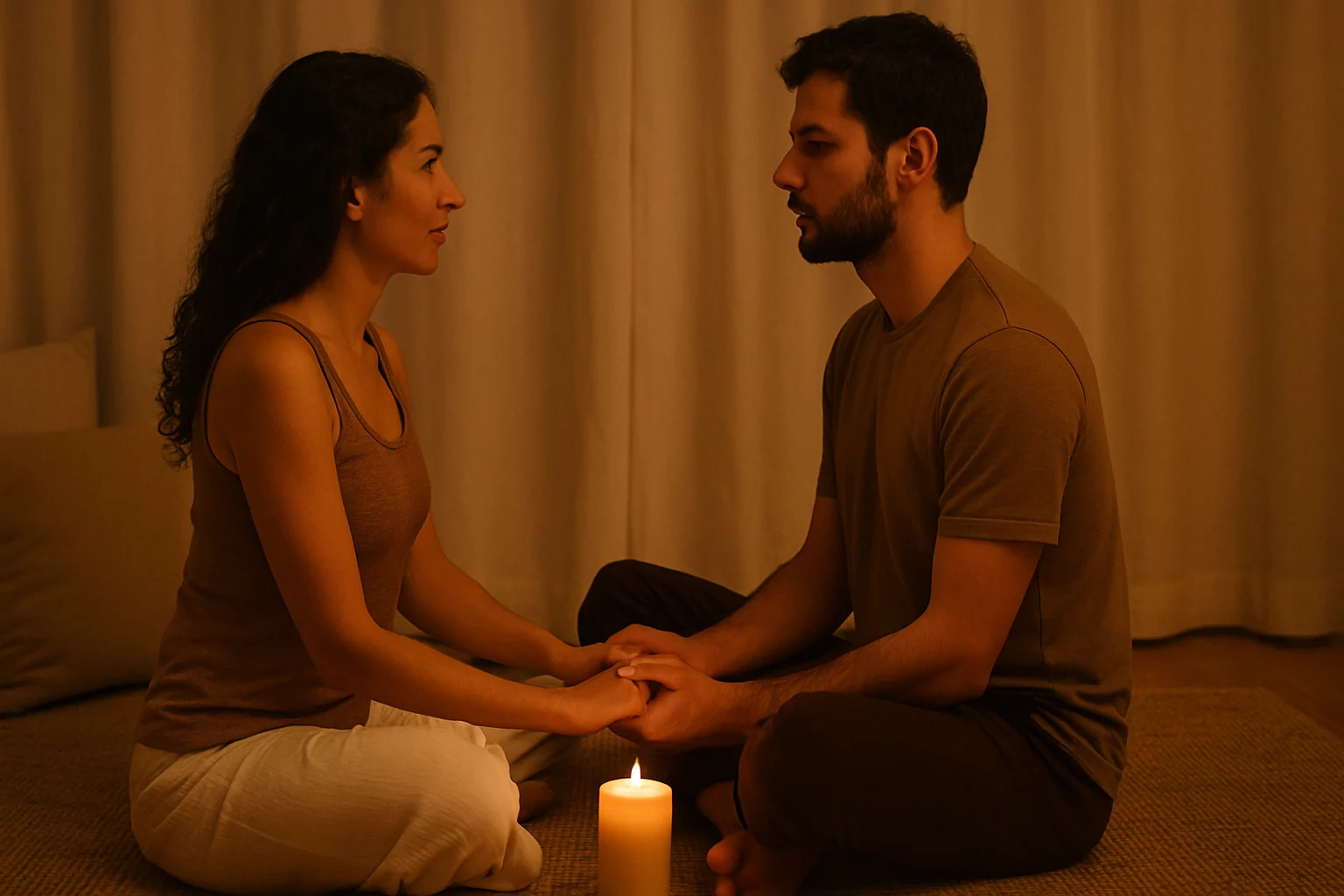
- Hands only. Low-stakes, easy to stop, and easy to say yes to on a day when more would be a no.
- Say what is welcome rather than what is not. Easier to hear and easier to act on than a list of limits, though both are legitimate.
Before you begin
Find a place to start
This is not an intimacy score, relationship assessment, or diagnosis. It returns one modest in-page prompt that can be changed, declined, or paused. If there is fear, coercion, threats, immediate danger, trauma distress, or a mental-health crisis, use the safety guidance above instead.
Choose both options to see your result.
Common questions
Leave with one honest next step
A useful practice can be brief, private, shared, adapted, or declined. The meaningful next step is the one that gives you more choice and less pressure, rather than a fixed routine or a promise to restore closeness.
This article provides general relationship education. It is not medical advice, mental-health treatment, trauma therapy, crisis support, or a substitute for qualified professional care. Do not use an exercise or couples process to manage coercion, violence, ongoing fear, trauma, a health concern, or a mental-health crisis.