

If you are wondering, “What can you do sexually after giving birth?” there is no single answer or required timeline. After giving birth, intimacy is optional—not a recovery milestone, a partner obligation, or a test of your relationship. There is no universal schedule for feeling physically or emotionally ready. The most useful next step may be rest, conversation, medical guidance, non-demanding closeness, or no intimacy at all. What follows offers a consent-led way to navigate those choices without telling you what your body is ready for. The physical side has its own depth — our women’s pelvic health guide covers it.
Table of Contents
- Start with permission
- What changes, and why
- Make space for healing
- Talk about closeness
- When to seek individual care
- Prepare a conversation
- Connection without demand
- Notice What Feels Welcome—Without a Timeline
- Common questions
- Choose the next kind step
Start with permission
A clear, freely given yes matters every time. So does a clear no, a pause, changing your mind, or not wanting to explain — and if putting any of that into words is the hard part, there are plain ways to say it. Neither parent owes sexual contact, reassurance through intimacy, or a return to a prior routine. The birthing parent’s recovery, comfort, privacy, and wishes deserve particular care; the non-birthing partner’s feelings can also be heard without becoming pressure.
“Not now,” “I’m unsure,” and “I want a different kind of closeness” are complete answers. A caring response makes it easier for consent to remain real.
What changes, and why
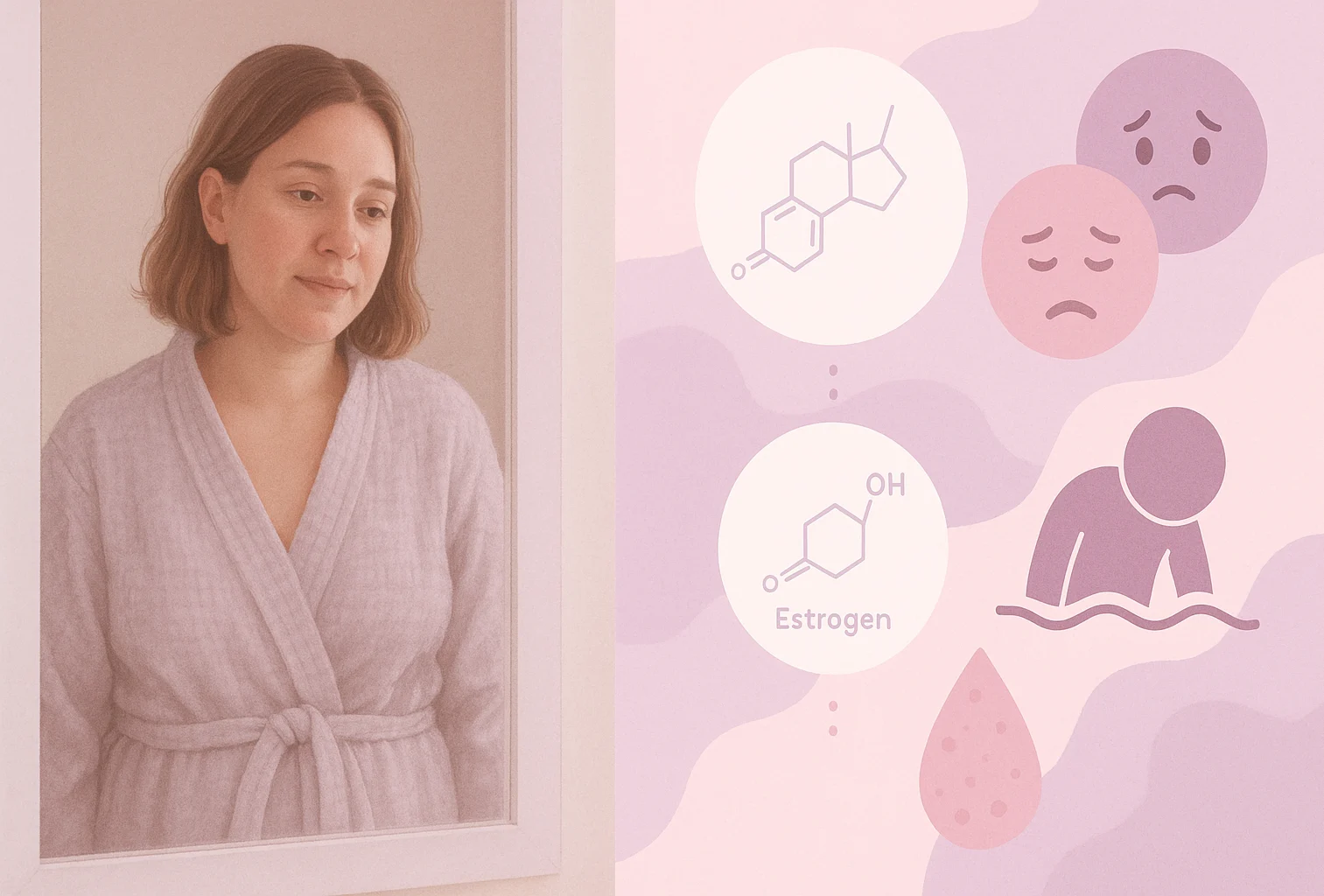
A lot of what people notice after birth gets read as a loss of desire, when several ordinary physical things are happening at once. Knowing which is which does not fix anything by itself, but it does stop the wrong conclusion.
Dryness is one of the more surprising changes, and it is usually hormonal rather than emotional. Lower oestrogen — especially while breastfeeding — commonly affects vaginal tissue and natural lubrication, though other factors can contribute too. It is extremely common, it is not a sign of how you feel about your partner, and it is a recognised thing to raise — there are straightforward options to discuss.
Healing takes its own time on top of that. Perineal tearing, stitches, or a caesarean scar each recover on their own schedule — and if the muscles themselves are the concern, that recovery is its own subject, and discomfort during that period is information rather than something to push through. Pain is a reason to stop and ask, never a reason to try harder.
Then there is everything that is not about the body at all: broken sleep, feeding through the night, and carrying someone else’s needs all day. Wanting nothing at the end of that is an ordinary response to exhaustion, not evidence about the relationship.
There is no schedule you are behind on. Whatever a friend, a book, or a six-week appointment implied, no timeline decides when this is welcome again — and the answer can be “not yet” for as long as that is true.
Make space for healing
Pregnancy, birth, sleep disruption, feeding, mood changes, pain, bleeding, medication, body-image changes, and relationship stress can affect how closeness feels. An online guide cannot confirm healing, determine medical safety, or give an individual readiness decision. If you are wondering whether an activity is appropriate for you, ask the clinician involved in your postpartum care.
Do not push through pain, fear, pressure, bleeding, or a sense that something is not right. Pausing is information—not failure.
Talk about closeness
A conversation can be more useful than a plan. Choose a quiet time outside a charged moment and name what you need with simple, specific language. The goal is not to negotiate someone out of a boundary; it is to understand what connection could feel respectful today.
| Conversation prompt | What it protects |
|---|---|
| “What kind of closeness feels welcome, if any, this week?” | Choice without assuming sexual contact. |
| “How would you like me to check in—and what should I do if you pause?” | Clear consent and a reliable stop response. |
| “Is there anything you want a clinician to help us understand?” | Individual guidance when health questions are present. |
| “What support would reduce pressure right now?” | Practical care, rest, and shared responsibility. |

When to seek individual care
Contact a maternity or primary-care clinician for new, persistent, worsening, or concerning symptoms, including pelvic or abdominal pain, heavy bleeding, fever, unpleasant-smelling discharge, concerns about an incision or wound, urinary or bowel changes, pain with movement or intimacy, or distress that is affecting daily life. Ask whether a pelvic-health or mental-health referral would be useful.
Use urgent care appropriate to your area for severe or sudden pain, heavy bleeding, fever with feeling unwell, chest pain, shortness of breath, fainting, inability to pass urine or stool, or rapidly worsening symptoms.
Prepare a conversation
It can help to note what you are noticing, what concerns you, what you hope for, and any questions about healing or emotional wellbeing. A clinician can help with a personal safety or recovery question; a website cannot make that call for you.
If relationship pressure, fear, sadness, anxiety, anger, or disconnection feels persistent or unsafe, professional support may be appropriate. If there is coercion, threats, or fear of a partner’s reaction, prioritize safety and seek confidential local support.
Connection without demand
Closeness can be shared care, a check-in, laughter, a walk, rest, affectionate words, a held hand, or time without any agenda. These are not steps toward a required outcome. They are choices that either person can accept, decline, or change.
A helpful agreement can be: “We will stop at the first sign of discomfort or hesitation, and stopping will not create a problem between us.”
Noticing what feels welcome, and what you might want to ask a clinician, is easier to do as it happens than to reconstruct afterwards.
Notice What Feels Welcome—Without a Timeline
Somewhere private to note what feels welcome, at whatever pace that turns out to be.
Confirm your email to receive it. Occasional emails, unsubscribe anytime.
Something went wrong. Please check your email address and try again.
Common questions
Choose the next kind step
Postpartum intimacy does not need to look like the past, and it does not need to happen on anyone else’s schedule. A respectful next step might be rest, a boundary, a conversation, professional support, or mutually chosen connection. What matters is that it remains freely chosen and responsive to the people involved.
This article provides general health and relationship education. It is not medical advice, diagnosis, treatment, or a substitute for individualized care. Seek urgent care for severe or sudden pain, heavy bleeding, fever with feeling unwell, chest pain, shortness of breath, fainting, inability to pass urine or stool, or rapidly worsening symptoms.