

On this site, “sensual healing” means optional sensory self-care: noticing what feels welcome, neutral, or not for you in a particular moment. It is not a medical term, a dopamine plan, a trauma practice, an energy claim, a sexual instruction, or a promise that a sensory activity will change your mood, health, relationship, body, or life.
Within women’s mental wellness, this is the lower-risk sensory-choice route: you do not need to feel a certain way, purchase anything, follow a ritual, use touch, use scent, move, breathe differently, share an experience, or continue an activity to take care of yourself. A pause, a boundary, privacy, a change of plan, or no activity are valid options.
Table of Contents
- What sensual healing means here
- Choice before a sensory activity
- Sensory options without a ritual
- Touch, scent, movement, and breath boundaries
- Privacy, sharing, and relationship safety
- When to use a different route
- Common questions
- Keep self-care optional
What sensual healing means here
The word “sensual” can mean attention to ordinary senses: texture, temperature, sound, light, smell, taste, movement, stillness, and surroundings. It may be useful as an embodiment or self-connection label. It does not tell anyone what they should enjoy, whether an activity is safe or suitable, whether they need care, or what a response means.
Self-care for sensual wellness does not need to become a special programme separate from ordinary self-care practices. Here, sensory choices stay optional: the label does not create a routine, an outcome target, or a reason to override comfort, privacy, access, or consent.
The approach here is deliberately low-claim: sensory language is used in a non-medical way. It does not claim to raise dopamine — what that framing can and cannot explain takes that on directly — regulate a nervous system, reduce anxiety, release trauma, heal pain, correct a hormone issue, improve fertility, change libido, repair postpartum concerns, replace therapy, or create a particular emotional state.

Choice before a sensory activity
Before an optional activity, you can ask: Do I want this? Is it practical right now? Do I have privacy and control? Can I pause or stop without explaining? Does it involve a product, another person, a cost, a physical demand, a belief, a memory, or a setting that I do not want to take on? If the answer is no, uncertain, pressured, or unsafe, choosing something else—or nothing—is enough.
There is no correct sensory preference. Other small options that need nothing bought work the same way. You may prefer quiet or sound, brightness or dimness, texture or no touch, activity or stillness, company or time alone. A preference can change from one moment to the next. It does not reveal a personality type, a health state, an energy block, a healing stage, or a need for a particular plan.
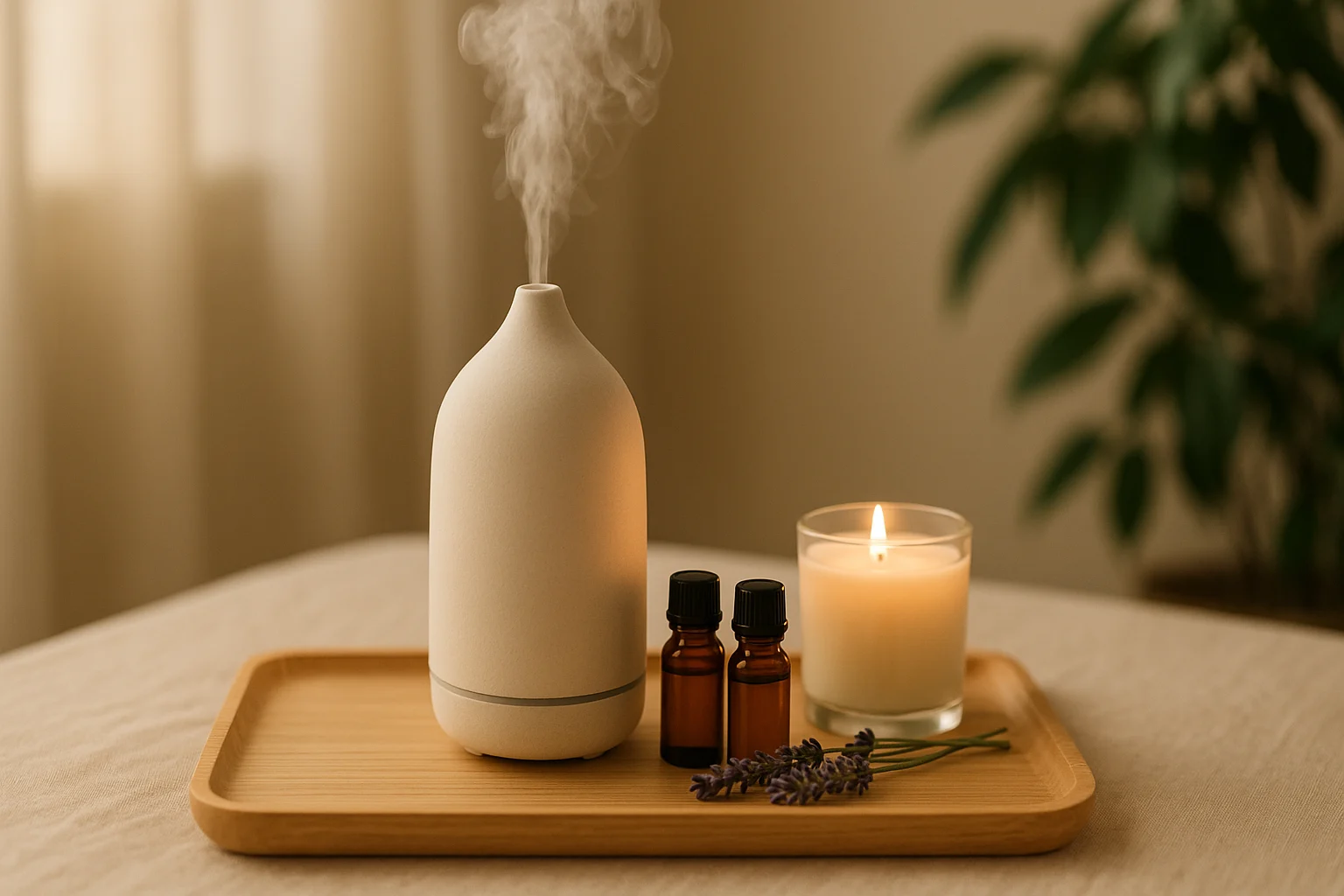
Sensory options without a ritual
The table below is not a prescription or mood-matching tool. It names broad categories people may choose to notice, modify, or leave alone. It does not say that any category has a particular benefit or is right for a particular feeling.
| Optional category | Examples of what someone might notice | Boundary to keep visible |
|---|---|---|
| Texture and temperature | Clothing, bedding, water, air, a cup, or a familiar object | Stop if the sensation is unwelcome, irritating, painful, or not wanted. |
| Sound and quiet | Music, background noise, conversation, an open window, or silence | You do not have to make sound, listen, share headphones, or stay where sound is overwhelming. |
| Light and visual surroundings | Daylight, curtains, a lamp, a view, colour, or a less busy space | A “cozy” space is optional; access, time, housing, and safety vary. |
| Scent and taste | Food, drink, soap, a plant, fresh air, or no scent at all | Do not treat a scent, oil, candle, or product as a health intervention or a required purchase. |
| Movement and stillness | Changing position, sitting, walking, stretching, dancing, resting, or doing nothing | No movement, pace, position, repetition, or outcome is required. Choose another route for a clinical or physical concern. |

Touch, scent, movement, and breath boundaries
Touch is always optional. No relationship, payment, booking, group norm, previous yes, self-care label, or instruction makes touch required. You can decide not to touch your own body, not to be touched, not to use an object or product, and not to discuss the reason. With another person, consent must be voluntary, specific, and ongoing; a previous yes does not apply to a new activity.
Scented, topical, and bath products are also optional. They may be unsuitable or unwelcome for many reasons. What a scented-bath product can actually claim covers bath-specific safety, while libido boosting essential oils separates intimacy marketing from product-safety and consent questions. There is no dilution, application, bath, ingestion, supplement, or product guidance here, and a sensory practice is not a substitute for product safety information.
Where breath is being taught as a practice, what a class actually involves sets out what to ask first. Movement and breath should not be converted into a test, treatment, trauma release, pelvic method, or standard routine. No position, pace, count, duration, frequency, or internal technique appears here, and there is no key for interpreting body sensations. Stop or choose a different route if an activity feels pressured, unsafe, physically uncomfortable, emotionally overwhelming, or like a replacement for needed care.
Privacy, sharing, and relationship safety
You do not have to make self-care visible, post it, describe it, perform it for a partner, share an image, attend a class, purchase an item, disclose a memory, or turn an experience into a ritual. Privacy is a valid boundary.
Ordinary lower-risk conversations about preferences can be useful when they are voluntary and safe, and how other people phrase a limit collects wording for them. Where there is fear, coercion, stalking, threats, control, monitoring, isolation, or violence, do not use a sensory activity, intimacy framing, conversation script, self-help page, group, retreat, product, or app as a safety plan. Prioritise confidential local specialist or emergency support. If there is immediate danger, contact local emergency services now.
When to use a different route
Use a different route for persistent, severe, unsafe, or difficult-to-manage changes in mood, energy, sleep, concentration, functioning, pain, sensation, movement, medication concerns, pregnancy/postpartum questions, pelvic-health concerns, trauma, eating concerns, substance-use concerns, or a need for treatment. A page, ritual generator, sensory preference list, coach, retreat, product, or app cannot diagnose, assess urgency, determine readiness, prescribe a response, or replace qualified local, confidential specialist or emergency support.
Sensory self-care should not carry the burden of making a person safe, resolving an urgent concern, or proving that they are healing. It is okay to choose a route that has nothing to do with sensory practice.
Common questions
Keep self-care optional
Sensory self-care can remain small, ordinary, private, or absent. There is no universal ritual, preference, product, pace, routine, mood target, or “inner glow” to achieve. Let choice and boundaries lead, and use a different route when the question is clinical, urgent, traumatic, unsafe, or bigger than an optional sensory activity.