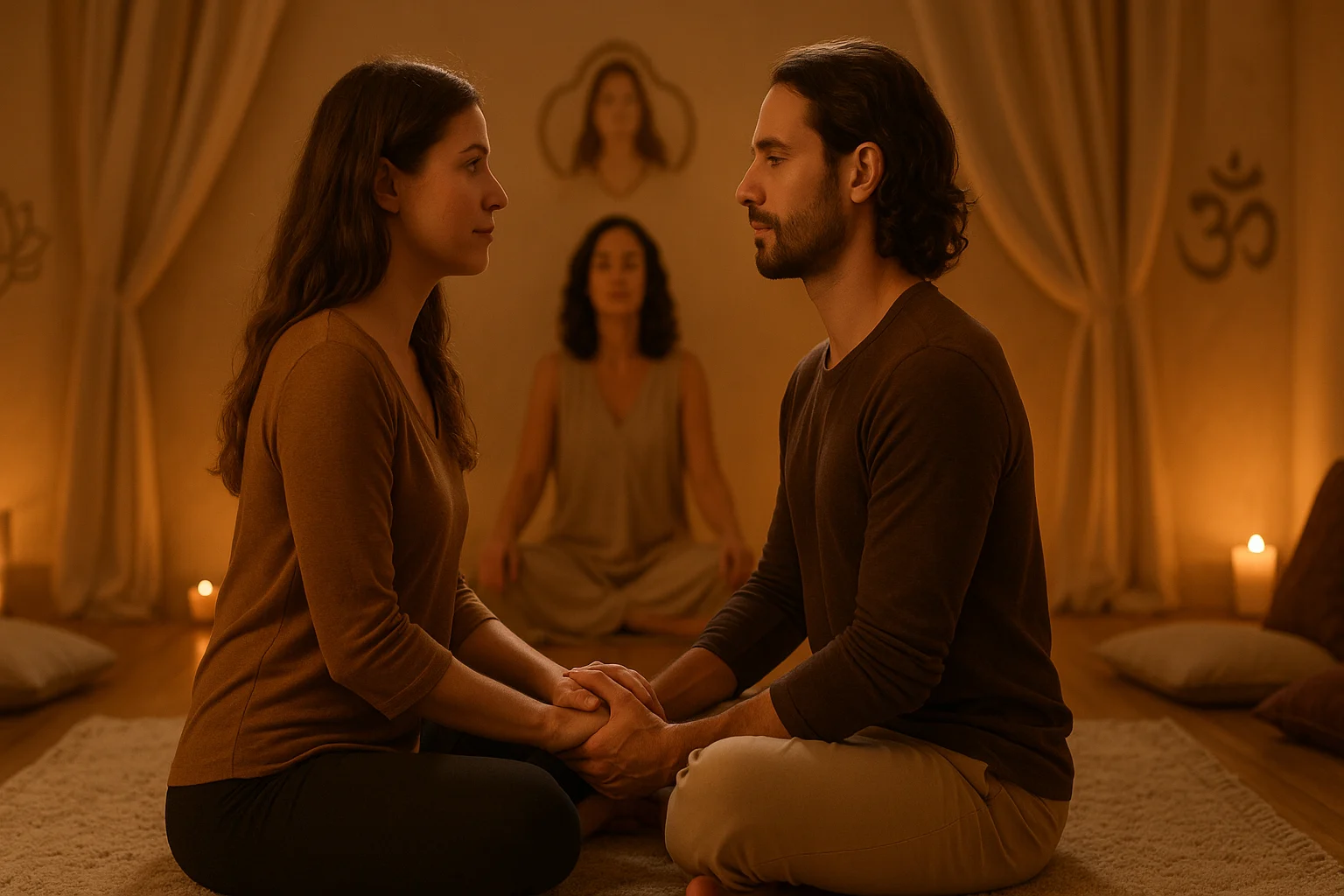
Couples tantric retreats share a name and almost nothing else. One is a communication-focused weekend, another a meditation-led program, another an adult-oriented event with a far broader interpretation of intimacy — and the word “retreat” in a listing rarely tells you which one you are booking. The useful question is not whether a retreat will fix or transform a relationship, but whether the format, boundaries, facilitator scope, and level of participation are a voluntary fit for both people. This guide helps you compare those details before you spend money or travel. For the wider relationship map, start with our women’s relationship wellness guide.
This post has affiliate links. We may earn a commission. As an Amazon Associate, I earn from qualifying purchases. Learn more.
Table of Contents
- Start with the real decision
- Work out your next step
- Compare retreat formats before you pay
- Use a booking checklist
- Choose a smaller or more private option
- When a retreat is not the right next step
- Know Your Own Answer First
- Frequently asked questions
- A voluntary plan is the useful plan
Start with the real decision
A retreat is a format, not a measure of how open, connected, adventurous, or committed a couple is. Some programs are mostly conversation, breath, movement, and structured reflection. Others may include optional partnered touch, spiritual language, nudity, or explicitly sexual material. None of those elements should be assumed, and no one should have to agree to more participation than they genuinely want.
Ask one shared question first: “What would make this feel useful and manageable for each of us?” If your answers differ, a conversation, a shorter workshop, or a free practice at home can be a better next step than booking a weekend.
Before you book
Work out your next step
Choose what you are considering and how settled the decision feels right now. You can stop, change your mind, or decide against a retreat entirely. If anything here feels unsafe or pressured, use the safety guidance below instead.
Choose both options to see one next step.
Compare retreat formats before you pay
The same words can describe very different experiences. Read the complete program page, not only the headline or photos, and ask for practical details in writing before you commit.
| Format | What it may offer | What to clarify before booking |
|---|---|---|
| Short workshop | A time-limited introduction to communication, movement, reflection, or agreed partner exercises. | Whether every activity is optional, how beginners are supported, and whether you can observe or step out. |
| Weekend retreat | More time away from routines, group sessions, meals, and private downtime. | Daily schedule, lodging, group size, cancellation terms, and exactly what participation is expected. |
| Adult-oriented tantra program | A program that may discuss or include broader sexual or sensual themes for adults. | Age requirement, privacy, clothing/nudity expectations, touch policy, and whether explicit material is optional or part of the program. |
| Private or at-home learning | A lower-pressure way to talk, read, or try a consent-led relationship exercise together. | Whether this better matches your pace before committing to travel or a group setting. |
For readers who want a structured but lower-stakes activity before considering travel, begin with intimacy exercises for couples or bonding exercises for couples. A shorter, consent-led class can also be easier to compare using our guide to couples massage classes.
Use a booking checklist
Before you pay a deposit, ask the organizer for answers that let both people make an informed choice. A responsible program should be able to answer without pressure or vague reassurance.
- What is the actual agenda? Ask for a sample schedule and the purpose of each session, not a promise of a particular outcome.
- What is optional? Clarify whether touch, sharing, movement, clothing choices, photographs, and group participation are opt-in—and how opting out works in practice.
- What is the facilitator’s scope? Ask what the facilitator teaches, what they do not provide, and how they handle concerns outside their role.
- How is consent handled? Look for clear language about checking in, changing your mind, taking breaks, and saying no without explanation.
- What are the practical terms? Confirm total cost, what is included, accessibility, privacy, lodging, cancellation/refund policy, and any required preparation.
Do not book through pressure. Pause if a person dismisses boundaries, promises to heal a relationship, discourages appropriate professional care, treats discomfort as resistance to overcome, or cannot explain the program’s participation rules.
Choose a smaller or more private option
You do not need a destination weekend to practice clearer attention or communication together. If a retreat feels too public, expensive, or fast-paced, try one conversation or structured exercise first. Our exercises for couple therapy give you a structure to try at home first. If the gap feels more like distance than logistics, building emotional intimacy is the better starting point. Neither treats a retreat as the answer to every relationship question.
For adults who want a more explicit private-study route: Urban Tantra, Second Edition by Barbara Carrellas covers modern tantra in far more explicit detail than this guide. It is private reading — not a booking guide, and not a substitute for screening a facilitator yourself.
When a retreat is not the right next step
A retreat is not a solution for coercion, violence, ongoing fear, sexual pain, a mental-health crisis, or a situation where either person cannot freely choose to participate. In those situations, prioritize immediate safety and qualified local medical, mental-health, or domestic-violence support. A group experience should never be used to force disclosure, repair, touch, forgiveness, or reconciliation.
If you are looking for an individual, non-explicit embodiment overview rather than a shared retreat, see our grounded guide to tantric sexual healing. It is not a replacement for support tailored to safety or trauma concerns.
A retreat asks you to agree in advance to things that are much harder to renegotiate once you are there. Knowing your own answer first is the cheapest part of the whole decision.
Know Your Own Answer First
Ten printable pages, private by design. Day four sorts what you would welcome, what you would reduce, and what is not right now — clearest to have settled before a booking rather than during one.
Confirm your email to receive it. Occasional emails, unsubscribe anytime.
Something went wrong. Please check your email address and try again.
Frequently asked questions
A voluntary plan is the useful plan
The best next step may be a retreat, a short workshop, a private book, a free exercise, or no action today. What matters is that both people understand the format, can name their boundaries, and remain free to change their minds. A useful experience does not require pressure, a promise of transformation, or a particular kind of participation.