

Pelvic floor exercises for beginners should start with context and comfort, not a routine copied from a chart. A safe beginning is not about forcing a routine or proving that a muscle is weak. People can experience pelvic symptoms for different reasons, and a generic online plan cannot determine whether strengthening, relaxation, other care, or no exercise is appropriate. This guide helps beginners recognize the limits of a webpage, prepare questions, and choose a safer next step. Our women’s pelvic health guide gives the broader context if you want it first.
This post has affiliate links. We may earn a commission. As an Amazon Associate, I earn from qualifying purchases. Learn more.
Table of Contents
- What a pelvic floor exercise actually is
- Start with the right question
- The release is half of it
- Know when not to self-direct
- Questions for a clinician
- What individual support can look like
- A gentle awareness check-in
- Start With Questions, Not a Routine
- Common questions
- Choose a supported beginning
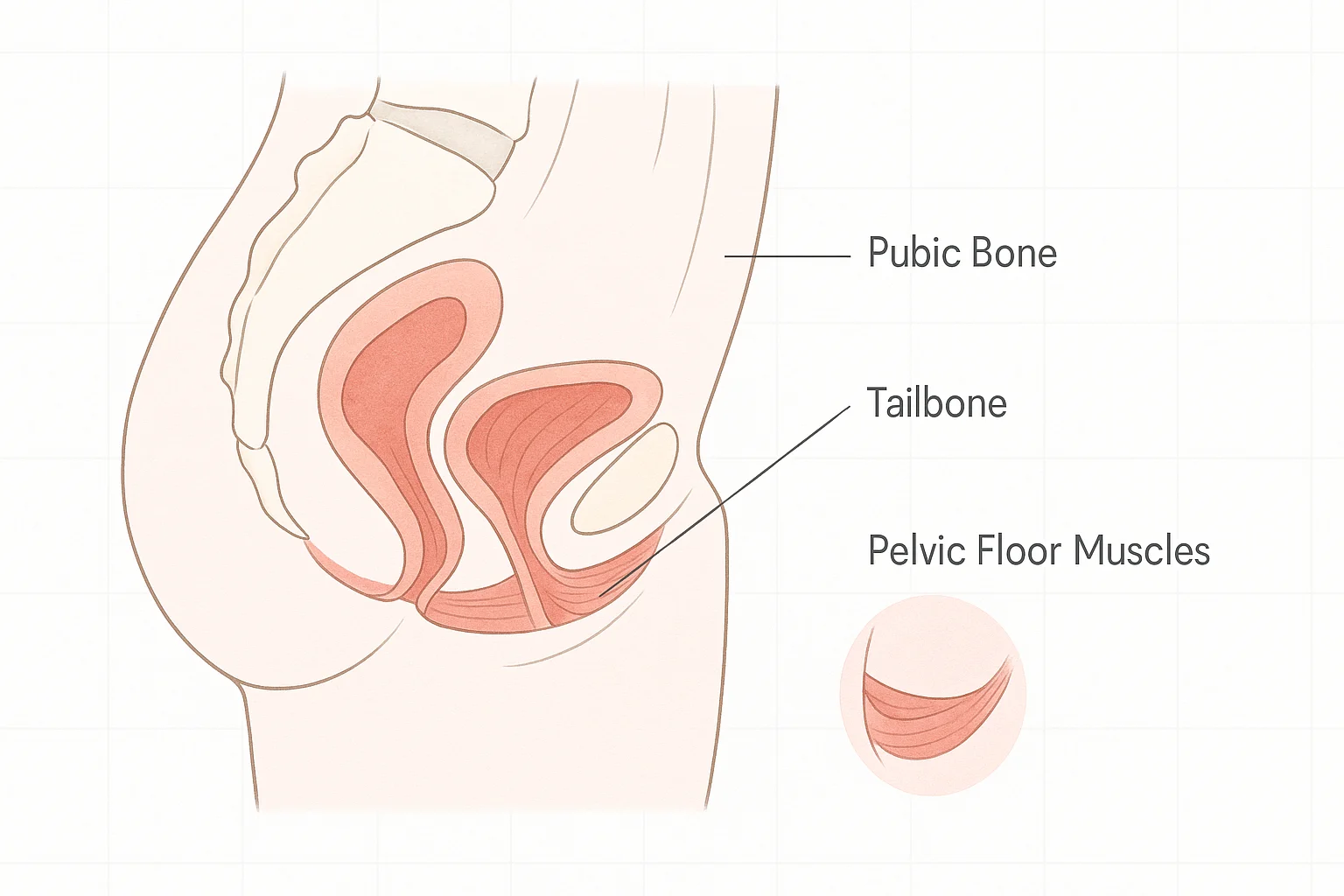
What a pelvic floor exercise actually is
Most pages on this topic move straight to a routine without ever saying what the movement is. It is worth describing plainly, because a lot of the difficulty beginners have is not effort — it is not being sure they are moving the right thing at all.
The pelvic floor is a layer of muscle spanning the base of the pelvis, supporting the bladder, bowel, and uterus, and involved in continence. Unlike most muscles, you cannot see it work, which is what makes it unusually hard to learn.
What people mean by a pelvic floor exercise — often called a Kegel — is a deliberate squeeze-and-release of those muscles. The description used by most health services is the muscles you would use to stop yourself passing wind, or to stop the flow of urine. That is a way of locating the sensation, not an instruction to practise while urinating: repeatedly stopping mid-flow is specifically discouraged, because doing it regularly can interfere with normal bladder emptying.
The common mistakes are worth knowing, because they are the reason many people feel nothing happening: bracing the abdomen, squeezing the buttocks or thighs, or holding the breath. Those recruit the wrong muscles and can mask whether the pelvic floor moved. This is exactly the part a clinician can confirm and a webpage cannot — checking that the right thing is moving is a physical assessment, and there is no way to do it by reading.
Which is why no reps, sets, hold times, or schedule appear here. Not because that information is secret, but because the number is the least important part and depends on what is actually going on. Getting a routine from an article and performing it incorrectly is the common outcome, and it can be worse than doing nothing.
Start with the right question
“What should I do?” can feel urgent when you notice leaks, pressure, discomfort, changes after pregnancy or surgery — and during pregnancy or after a birth the question has its own shape, difficulty with bladder or bowel habits, or uncertainty about your body. But a symptom does not identify the right kind of exercise. The useful first question is: “Would pelvic floor exercise be appropriate for my individual situation, and who can help me learn safely?”
It is valid to begin with education, rest, a referral, or no exercise. A qualified clinician can help distinguish between different needs and priorities.
The release is half of it
Public advice about the pelvic floor is almost entirely about strengthening it. That leaves out something important: letting go fully is as much a part of the movement as tightening, and a muscle that never releases is not a strong muscle — it is a tired one.
Some people have the opposite of a weakness problem. A pelvic floor can be overactive: held tight, slow to relax, working when nothing is asking it to. Where that is the case, more squeezing is not obviously the answer, and can be the wrong direction entirely. Symptoms are not a reliable guide here either — pain, leaking, urgency, and difficulty emptying all show up on both sides of that line, and the two can occur together.
This is the single strongest argument for asking before starting rather than beginning with a routine found online. “Beginner” describes your experience, not your diagnosis, and the two are not the same thing. If your question is about the release side specifically, that category has its own page, with its own limits.
Know when not to self-direct
Do not use an online routine, quiz, or product page to manage pelvic pain, pressure or bulge symptoms, new or worsening leakage, bleeding, pregnancy concerns, recent birth or surgery, numbness, difficulty emptying the bladder or bowel, infection concerns, or a history that makes internal/body-focused work distressing. Seek individualized care instead.
Use urgent care appropriate to your area for severe or sudden pain, heavy bleeding, fever, inability to pass urine or stool, blood in urine or stool, or rapidly worsening symptoms.
Questions for a clinician
| Question to ask | Why it helps |
|---|---|
| “Are pelvic floor exercises appropriate for my symptoms and history?” | It prevents a generic routine from standing in for assessment. |
| “Could a pelvic-health referral help me understand my options?” | It opens a path to individualized guidance. |
| “What signs mean I should stop and check in?” | It creates a clear reversal plan. |
| “Are there non-exercise approaches that might be more appropriate?” | It makes no-exercise and alternative care valid outcomes. |
What individual support can look like
Individual care may include conversation, assessment, education, attention to daily activities, referral, or a plan that changes over time. A clinician can help you understand whether the aim is strengthening, relaxation, coordination, another intervention, or simply more information. A website cannot make that distinction or confirm technique for you.
Ask for explanations in plain language. You can pause, decline any part of care, request a different provider, or bring support to an appointment if that helps you feel safe.
A gentle awareness check-in
If you want to begin without a routine, notice your current experience for a moment: are you aware of pain, pressure, fatigue, anxiety, ease, or uncertainty? You do not need to interpret, correct, or change what you notice. This information can be useful to bring to a clinician.
No score or progress target is required. Learning what you need and seeking support are meaningful beginnings.
Floored by Sara Reardon, a board-certified pelvic-floor physical therapist — a longer read for understanding the whole system before deciding what fits. General education, not a personal exercise prescription.
If the awareness check leaves you with questions, write them down now — they hold up better on paper than in memory by the time of the appointment.
Start With Questions, Not a Routine
Room for the question, kept private — no routine attached to it.
Confirm your email to receive it. Occasional emails, unsubscribe anytime.
Something went wrong. Please check your email address and try again.
Common questions
Choose a supported beginning
Beginning can mean asking a question, describing a symptom, getting a referral, taking a pause, or choosing a plan tailored to you. You do not need to earn help through a generic routine. If you are weighing whether a device would help, that is a separate guide. If endometriosis is part of the picture, whether pelvic floor therapy helps with it is the closer read.
This article provides general pelvic-health education. It is not medical advice, diagnosis, treatment, or a substitute for individualized care. Seek urgent care for severe or sudden pain, heavy bleeding, fever, inability to pass urine or stool, blood in urine or stool, or rapidly worsening symptoms.